


Beginner's Guide - The Causes of Climate Change
- Sarah S.

- Dec 1, 2019
- 6 min read
[ THE BEGINNER'S GUIDE TO CLIMATE CHANGE ]
We all hear about Climate Change all the time, everywhere. On the news, on social media and, of course, even on this website. But what is Climate Change really and why do some people still deny it when it’s seemingly everywhere? To answer this question and to see where to start in our reforms, we must look at the many possible causes of Climate Change...

NATURAL CAUSES
Before we take a look into the fossil fuels and human factors which we always hear about, first we must recognise that the climate has always been changing and will always naturally change.

Although this graph may look confusing at first, it highlights an interesting pattern which many use to deny Climate Change. The glacial-interglacial cycle. In basic terms, this graph shows how the Earth naturally has colder periods (glacials, shown by dips in the graph) followed by warmer periods (interglacials, shown by peaks in the graph) with fluctuations occurring throughout. Moreover, it also shows the relationship between carbon dioxide in the atmosphere and temperature which points to the modern greenhouse theory we will be looking at later.
I’m sure you’re thinking ‘wait, but how do we know what the climate was like 425,000 years ago?’. And you’d be justified in thinking that; it’s good to look at your sources, especially when looking at climate science. The method used to take these readings is by taking ice core samples from Antarctica (this particular graph used the cores from the Vostok station). As Antarctica is an environment untouched by humanity for the most part, it is a good way of seeing how climate has changed.
The cores are separated into layers which distinguish the passage of time: as the snow would continue falling, it would press down the ice below it, forming layers. We can tell the different time periods is by looking at the organisms found in these layers. The incredibly clever part is how isotopes of oxygen and hydrogen within these ice cores are measured to determine the temperature at that time. It’s a very complex science and if you’d like to learn more about it, there are plenty of resources available online, for example antarcticglaciers.org might be a good starting point as it has links at the bottom for extra research.
So, what causes these natural changes in Earth’s climate?
Scientists have concluded three main factors:
Eruptions release particles of dust in the atmosphere which block around 5-10% of the sun’s energy. They also release sulphur dioxide which forms sulphuric acid droplets in the atmosphere. These act as tiny mirrors and reflect the sun’s radiation away, causing Earth to cool. However, out of all the natural causes, this is perhaps the most short-term as these particles only remain in the atmosphere for around 3 years.
The sun goes through an 11-year cycle where it cycles between a minimum solar output (causing cooling on Earth) to a maximum solar output (causing higher temperatures on Earth) and then back to the minimum output. This solar activity can be measured by looking at the sunspots on the surface of the sun.
These orbital changes are most likely what caused the glacials and interglacials as seen above. Changes in the orbit cause the distance between the sun and the earth to differ, leading to variation in the amount of energy received from the sun. There are three of these cycles, known as eccentricity (the shape of the orbit changing from being elliptical to circular) which occurs over 100,000 years, axial tilt (the Earth changing the incline of its tilt from 21.5°-24.5°) which occurs over 41,000 years and precession (the wobble as Earth spins on its axis) which occurs over 23,000 years.
Although each of these cycles have different effects - for example, axial tilt affects seasons with a steeper tilt leading to more defined differences in the seasons - and occur over different periods of time, it’s reasonable to see that some of these cycles working with each other would lead to the periods of glacials and interglacials which naturally occur. This is, of course, a very intricate and complex science and this brief whistle-stop tour of causes cannot possibly go into all the details. However, if you’re interested in learning more, I recommend these links:
HUMAN CAUSES
Looking at these natural causes and cycles, it might be easy to write-off modern day Climate Change as merely the normal warming of the Earth as we emerge from a glacial period. However, in order to debunk this, we must look at the warming in recent years.

This graph displays very clearly that although the temperature was already increasing, the increasing rate is very alarming. The speed at which the temperature is increasing is much more than would be expected from the natural cycles. Moreover, the effects of such rapid global warming are very serious as they create a positive feedback system - leading to an even larger increase in rate without giving much time for species to adapt. However, we will be focussing on these impacts in a later article. Instead, let’s take a look at what has been driving this increase since the mid-1800s.
Of course, one of the defining moments of the 19th century was industrialisation. This led us to start burning fossil fuels, such as coal, and releasing huge amounts of greenhouse gases such as carbon dioxide into the atmosphere. In order to see how this impacted the climate, we need to first look at the natural greenhouse effect.
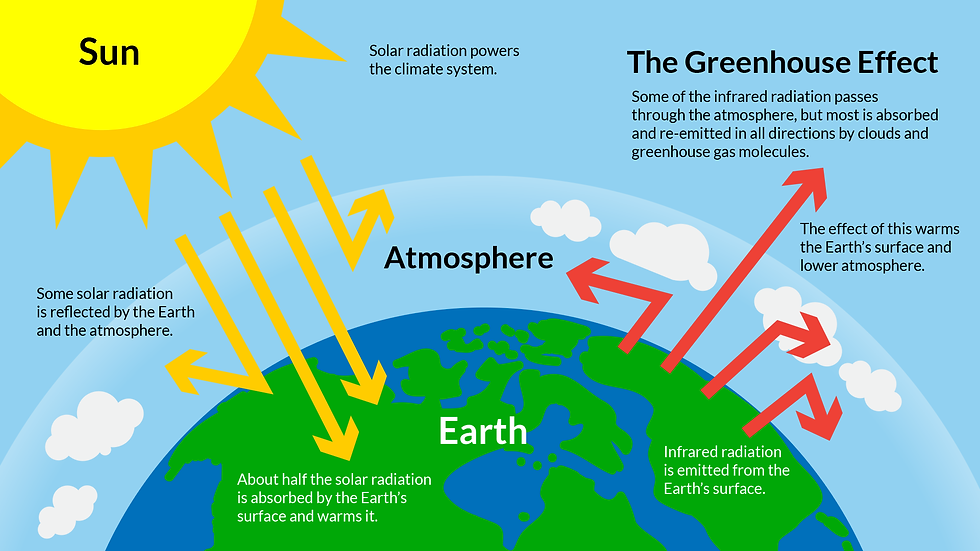
The natural greenhouse effect can be laid out in very simple steps:
Short-wave ultraviolet radiation from the sun passes through the atmosphere and heats up the Earth.
The earth absorbs the ultraviolet radiation and re-emits it as long-wave infrared radiation.
Certain greenhouse gases in the atmosphere absorb this infrared radiation and store it as heat.
Greenhouse gases include carbon dioxide (responsible for 64% of man-made global warming), methane (responsible for 17%), nitrous oxides (responsible for 6%) and fluorinated gases. In short, the atmosphere almost acts as a blanket which keeps heat in, around the Earth. This is, like before, a natural process. In fact, this is a very necessary process and without it life as we know it could not have possibly been sustained on Earth.
What’s the problem?
Humans, ever since the industrial revolution, have been producing more of these greenhouse gases which in turn trap more of this radiation and cause the Earth to heat up - so far by about 1.5°C.
The concentration of carbon dioxide in the atmosphere is currently more than 40% higher than it was when industrialisation began! It’s not the greenhouse effect itself which is the issue, it’s our man-made amplification of it. In its Fifth Assessment Report, the IPCC concluded there's a more than 95% probability that human activities over the past 50 years have warmed our planet. But what are these activities?
Some examples include:
Burning coal, oil and gas (fossil fuels) produces carbon dioxide and nitrous oxides.
Deforestation prevents trees from absorbing carbon dioxide and the carbon stored in the trees is released into the atmosphere.
Cattle and sheep farms produce large amounts of methane when they digest their food.
Fertilisers containing nitrogen produce nitrous oxide emissions.
Fluorinated gases produce a warming effect up to 23,000x greater than carbon dioxide (luckily, these are released in smaller quantities and are being mitigated by EU regulation).
In short, any activity which releases greenhouse gases into the atmosphere.
Looking at this, I think it is necessary to pause for a minute. These figures appear incredibly bleak and it seems that humanity has dug itself into a hole it cannot recover from. They portray an upsetting vision of hubris wherein we strive for economic ‘progress’ while ignoring the environmental impacts. Climate science is utterly depressing as it exposes all of our avoidable mistakes, right?
I disagree.
Although it can be easy to look at these man-made causes of climate change and feel sick with regret as you realise how you have contributed to your own possible demise, I think we often overlook something important. The fact that these figures exist and that anyone (both me as I write this and you as you read this) can learn about the causes with little experience or prior knowledge seems to display a spark of hope. The fact that there is so much awareness and concern to study these causes conveys an odd hope. The hope that we have a chance. Moreover, this is not an elitist field - which is why I write and why I urge you to share articles. Anyone can now disprove those who disregard Climate Change as a ‘natural change’. Anyone can now understand their impacts on the world. Everyone should now be able to see the need to change our habits.
And that’s why I find it so oddly exciting the more we understand why the climate is changing. Yes, we have made mistakes. But now as we understand what we did wrong, we can improve. We can learn from these mistakes and build a better world. And we need to do so, now more than ever before.


Comments